

EMBRACING THE GROTESQUE: TALKING WITH LISA HANAWALT
The Rumpus | DW McKinney | November 20, 2020
The Rumpus | DW McKinney | November 20, 2020
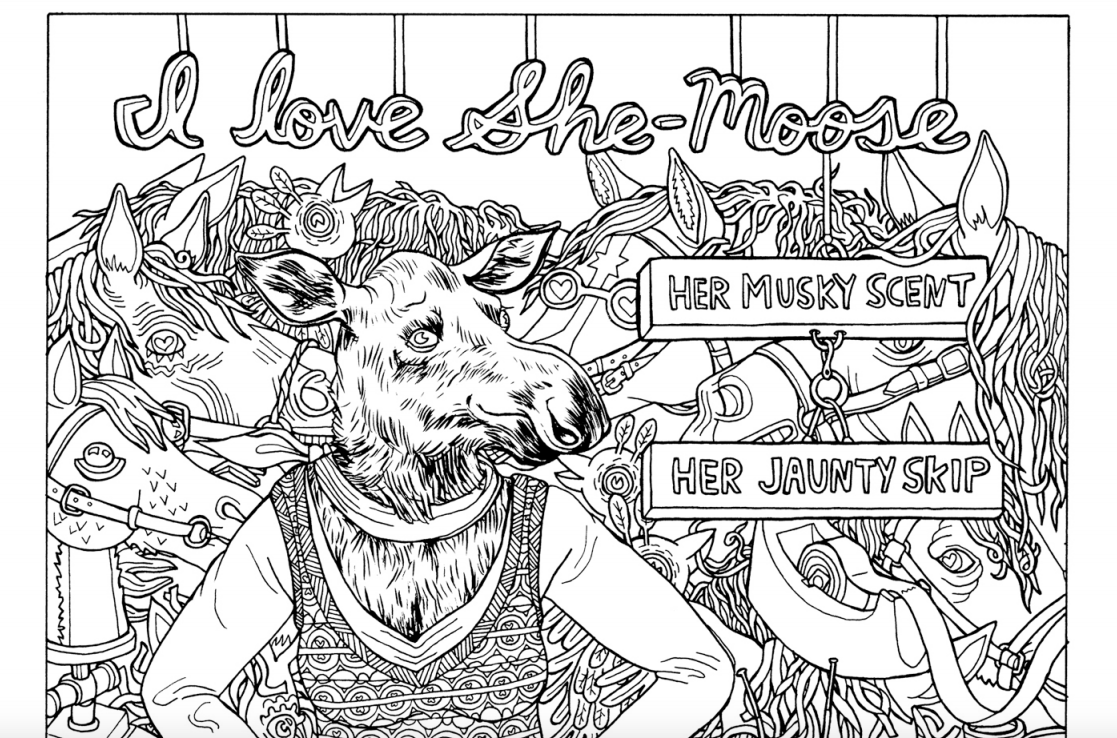
I Want You begins with Lisa Hanawalt drawn as a young bird in her twenties, crouched on a chair at her desk, sketching away. As she ages, her computer and telephone become more technologically advanced, the dog at her feet is continuously replaced with a different one, and her body shows the wear and tear, or rather, amputation of time. Along the way, Hanawalt acknowledges that her past mistakes did not end her career. Saying “no” is a powerful tool. And though she is wiser than she was before, she has just enough answers to help those younger than her—as was the case for me during our interview. Most people will recognize Hanawalt’s creative fingerprints on the Netflix tragicomic animated series BoJack Horseman, where she was the production designer, or on Tuca & Bertie, an animated show Hanawalt created about two bird women voiced by Tiffany Haddish and Ali Wong, respectively. But Hanawalt is a woman of many talents. She co-hosts Baby Geniuses, a podcast, with comedian Emily Heller. Her comics have appeared in the New York Times, Hazlitt, and VICE. The Hairpin even featured a series of her humorist film reviews for a time. She also illustrated a children’s book, Benny’s Brigade (2012), in addition to authoring her own graphic novels: My Dirty Dumb Eyes (2013), Hot Dog Taste Test (2016), and Coyote Doggirl (2018). I Want You is a compilation of Hanawalt’s early mini comics, illustrations, and art. It is her at the very beginning of it all. We spoke recently over Zoom about using nightmares as inspiration, reading reviews of your own work, and sex bugs.
***
The Rumpus: In your introduction to I Want You, you talk about how reviewing old work brings up painful memories and can be embarrassing, and it being like revisiting a dump in the toilet. How is it for you right now? How are you coping with the mixed emotions of promoting work that you’ve distanced yourself from in some way?
Lisa Hanawalt: It’s interesting. I felt really ambivalent about reprinting that work. I just wasn’t sure about it and then Drawn & Quarterly and my literary agent both kept reassuring me that the work was worth collecting and reprinting. My instinct is to just let the past be the past and just move forward because everything I make is building on something in the past and trying to improve on it. In some ways, I’m telling the same stories over and over again but just refining how I tell them. But when I actually look back through the work, I’m like, Okay, this stuff is interesting. And you can kind of see the germination of so many of my ideas and my characters. Maybe it does stand on its own. And it’s just been nice seeing people’s reactions to it. You’ve kind of figured nobody’s going to care about this. They’ll be like, Oh, she just repackaged some old work. But I think people are happy to have it collected. There’s a lot of rare and previously unpublished stuff in there, and I think the intro comic helps contextualize it. I don’t know. I’m bad at talking about my own trajectory and my career as an artist so then reading other people reviewing it and summarizing my career is really bizarre. People seem to like this work.
Rumpus: You’re really open about your mental health in your comics, and you often discuss anxiety. Do you use your art as a medium for your own mental health?
Hanawalt: I think I drew a lot when I was in elementary school because I was anxious. And because I had trouble focusing, unless I was fidgeting or doing something with my hands.
So really, I think I got good at drawing because I was doing that throughout school. Teachers would yell at me and try to get me to stop, and I wouldn’t. It was hard to explain to them, “I can listen better if I’m drawing at the same time as I’m listening.” It’s not an either-or thing. It’s hard to focus. I think drawing helps me and it also feels cathartic to sort of take something that feels bad and turn it into something that feels good. You feel accomplished. I don’t know. I like feeling useful to other people. I think my job is largely inessential and useless, but if my work helps someone else feel like, “I feel the same way,” then I feel better. That’s satisfying.