

The Personal Statement
The Comics Journal | Bob Levin | March 25, 2021
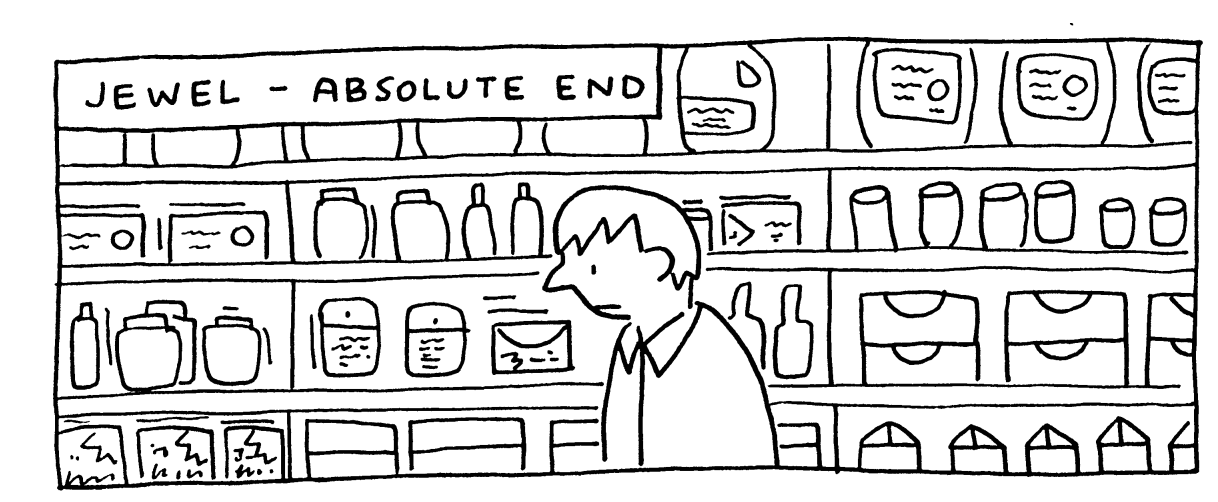
The Comics Journal | Bob Levin | March 25, 2021
There was this question of how I come up with the “off-the-beaten path” subjects I write about. The editor wondered if I would read a “major figure.” He wondered, for example, what I would make of John Porcellino. He thought my treatment of my major illness[1] would interest me in Porcellino’s treatment of his, like we had pulled matching decoder rings out of the cosmic Cracker Jack box, enabling special understanding of one another. Drawn and Quarterly sent me King-Cat Classix and Map of My Heart, its 2020 two-volume reprinting of Porcellino’s Best of King-Cat Comics and Stories (1989 - 2002), accompanied by his Perfect Example (D&Q. 2020). Since I had never read Porcellino and Perfect Example was 129 pages vs. the 727 of the collected Cats, it seemed a good place to begin. I. If I have this right, King-Cat is a self-published, autobiographical mini-comic, from which, in 2000, Highwater Books combined two stories, one from issue 52 (May 1997) and one from issue 53 (Feb. 1998), both set between May 1986, the end of Porcellino’s senior year in high school in Hoffman Estates, a suburb of Chicago, and August 1986, before his departure for college, and published them as Perfect Example. This book was republished by D&Q in 2007, but its most recent edition is the only one I have seen. It contains a near three-page “Resume and Relevant Information” Porcellino seemingly wrote for it. Other than that, I have no idea how it differs, if at all, from the 2007 or 2000 editions, or how they may differ from the original stories in King-Cat.[2]
Anyone who has read other cartoonists’ accounts of high school is unlikely to find Porcellino’s especially surprising. (It may not even surprise anyone who’s been to high school.) The most surprising thing to me was how out-of-the-1950s life in 1986 Hoffman Estates seems to have been. The kids drink but do not do drugs. They make out but do not have sex.[3] The problems of the outside world do not intrude upon them. Everyone is heterosexual. Everyone is as white as the characters in “Peanuts,” B.F.[4] This “sameness” is accented by Porcellino’s drawing. I often found it difficult to distinguish one character from another. I often found it difficult to distinguish boys from girls. At one point Porcellino refers to himself as “fat” but he seemed no chubbier than anyone else. (Little Lulu’s Tubby, he is not.) Dialogue does not often aid differentiation. “Blah,” one character says; “Blah,” another answer. A second conversation consists of “Chit” and “Chatter.” (Actually, I liked both.)
Sometimes the background of outdoor night scenes are as blank (“light”) as outdoor day scenes. Even time barely matters. “Later,” “a few days later,” “some weeks later” sit atop panels; one event is over and another has begun. From Perfect Example, John Porcellino, D&Q And these events are not momentous. Porcellino and friends go to class, clubs, concerts, visit thrift stores, Chicago, party by the lake or each other’s homes, skateboard, talk on the phone. Throughout though, Porcellino sets himself apart. He is unable to “fit in,” lacking in direction, “sad,” occasionally suicidal. “(N)othing ever turns out as [he] hope[s].” Everything is “shitty.” Everything seems a “waste.” (“N)othing really matters... (T)hings (are)... no more real than shadows on a wall.” But one mid-summer’s day, while mowing his lawn, he experiences an epiphany. He realizes that he creates his “unhappiness” “(T)hings aren’t in themselves good or bad. It’s the way I react to them...”[5]All he must do is change his reactions. And at book’s end, having immersed himself in nature, having hiked past rocks and logs and over “moist, mossy earth,” sun breaks “through the darkness,” and he is “very happy.” Porcellino omitted from his portrayal of his pre-college self that he was already creating the comics and zines which would become the focus of his adult life.
He also omitted any exploration of his earlier years which might have provided insight into the development of the adolescent he became. Which brings to mind a second surprising thing about Porcellino. I cannot recall an UG/ALT cartoonist who expresses such consistently warm feelings toward his parents. (I can barely think of a friend or relative who does.) Whether he is driving 1000 miles alone in a car with his father or weeding a garden with his mother, only positivity (and cartoon “hearts”) vibrate. (The sole exception – a brief one – occurs when nagged about a haircut.)
Read the rest of the article here.