

The Sky Is Blue With A Single Cloud
The Comics Journal | Brian Nicholson | July 29, 2020
The Comics Journal | Brian Nicholson | July 29, 2020
I have to admit that the reason this book initially intrigued me is most likely a coincidence. Last year, the record label Light In The Attic reissued Sachiko Kanenobu’s Misora (“Beautiful Sky”), an album of Japanese folk music from 1972. In the sense of a singer-songwriter performing their own material on acoustic instruments, rather than traditional songs, Kanenobu was apparently the first woman to do this in Japan, making her a trailblazer of sorts. The Sky Is Blue With A Single Cloud has a title similar enough to highlight the parallels in the provenance of its contents.
Kuniko Tsurita’s manga began appearing in Garo magazine in the late sixties, when she was eighteen, making her similarly a pioneer for being the first woman making experimental manga, disinterested in the commercial potential that might await one making work explicitly targeting an audience of young girls. I have no way of knowing if either of these women would’ve been aware of or interested in the work the other was doing; characters in Tsurita’s manga listen to American jazz drummer Max Roach. It is simply a byproduct of a current American vogue for archival work from certain places, time periods, and feminine or feminist viewpoints that led to them entering the marketplace and my consciousness in such proximity to one another. For all the interest the broad strokes of her biography can generate as a marketing hook to a North American audience, considering the peculiarities of Tsurita’s stories finds them strange and compelling. Coincidentally, they’re also also abstract enough they often move more like music in how they develop and digress, rather than seeming to follow a plot and a three-act structure.
Compiled here, they play off each other like songs an an album, or suites in a symphony. It begins with a piece that’s relatively accessible. Its story, of someone who goes around killing bad people, and is then sentenced to hell himself, and then proceeds to kill the souls in hell, only to be returned to the Earth again, is basically dumb enough to be Spawn. It’s also the work of a literal teenager, and shot through with inventiveness in its visual storytelling and paneling. One great page, depicting a prisoner being walked away from the jail to the gallows, increases the number of bars visible in the foreground as the figures move further away, precedes another great one, where the silhouette is distorted in two different ways, in an abstracted depiction of a soul’s descent into hell. The pageturn between them increases the impact of both the slow measured march towards the inevitable of the first and the new sensation of impossible pain of the second.
It’s an uncomplicated fable about wrongheaded delusions constituting an existential trap that makes one’s fate, and this self-awareness elevates it above the power fantasies of vengeance built around confusing metaphysics it resembles. When this story ends, readers are instructed to go back to the beginning and reread until we understand it, but the meaning is easy enough to grasp that such instruction feels a little condescending. Still, it’s the earliest piece included in the book, and some uncertainty on the author’s part can be excused. (It’s also titled “Nonsense,” which might be a form of self-deprecation.) Later pieces are free from such authorial intrusion, but benefit from immediate rereading to reveal the amount of forethought and construction underpinning their more oblique shapes. “R,” from 1981, feels similarly cyclical in its construction, with the narrating voice in its first panel taking a retrospective tone regarding the story’s conclusion.
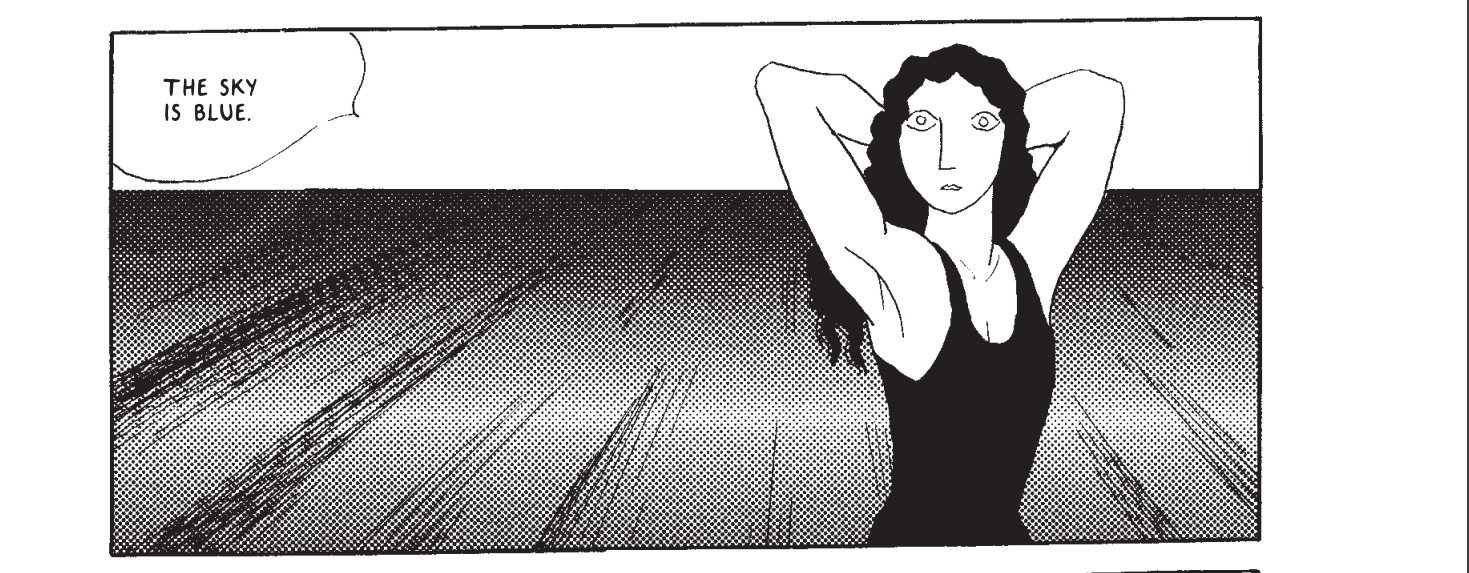
The story chronicles the growth of a child, and while initially the child’s appearance is drawn with a Tezuka-like cuteness, much as a child in “Nonsense” also appeared, their growth into adulthood is depicted with a style closer to Guido Crepax, a microcosm for the development in Tsurita’s style more generally. It doesn’t actually feel like Crepax, partly due to the subject matter never approaching the pornographic, and partly because in Tsurita’s hands the inexpressiveness of her lines feels deliberate and not undercutting. Though the level of ornamental detail feels European, Tsurita’s approach to drawing faces feels closer to the masks of Kabuki theater than celebrity models, and the rest of her drawing follows an approach that favors a neutral distance that allows the reader to consider what is being conveyed without feeling the author’s trying to seduce them. If comics are a combination of literature and visual art, which I think we can all agree they are, the literary effect of Tsurita’s more mature work is served by being able to take in the whole story as viewed as a single composition.
First and last pages feel more like focal points to consider than the beginnings and endings of a story which a reader’s imagination can then extend in either direction. The story “Max,” for instance, rhymes these pages by having a very similar composition- two shots of the title character sitting in a chair, the front and from behind, and a close-up of her mouth smoking a cigarette. Reading “Max,” a sense emerges, present also in a story called “Calamity,” that the end of the story - all our stories - is death, and while we can perhaps look back to review our lives and have regrets, the fact of death as an inevitability was always going to be a foregone conclusion. “Calamity” is a story, like “Nonsense,” where a character is condemned to death despite their viewing themselves as innocent; unlike “Nonsense,” we don’t see the protagonist committing crimes, only being introduced after they’re imprisoned.
Read the rest of the review at the link above.