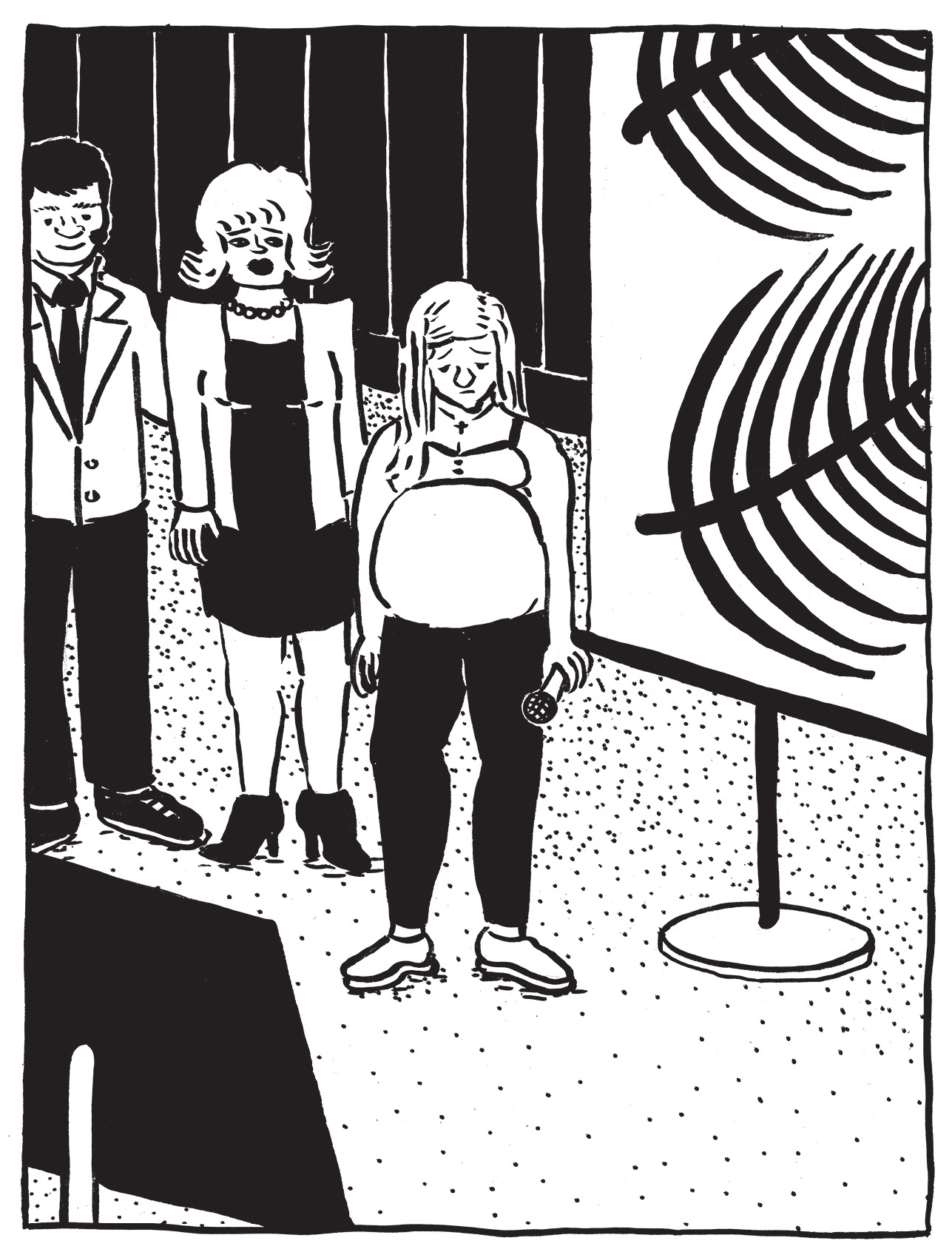
What happens when an evangelical church becomes a main character in a graphic novel? You get a quietly simmering tale of what happens when teens begin to question the space it consumes in their lives.
Rave, Jessica Campbell’s first fictional graphic novel, explores one young woman’s relationship with the church as she embarks on her first lesbian love affair. Campbell’s first foray into comics,
Hot or Not: 20th Century Male Artists (2016), lampoons our culture’s obsession with looks. This time, Campbell tackles the (conservative Christian) church, with some of that same humor, but much more anger. While Campbell may be better known for her fiber paintings and sculpture (such as the psychedelic La-Z-Boy covered in neon green car wash mitt material), her new graphic novel tackles what she refers to as “the cycles of violence and repression” within some conservative, evangelical communities. To capture the hypocrisy Campbell herself experienced as a teenager growing up in a conservative church, she turned to fiction to incorporate her friends’ experiences, news stories, and more.
As soon as readers open to the first page, it’s evident what the story’s central force is: the cross and all its trappings draw attention like a bullseye. And, we enter those eaves to watch a pastor discuss “
sexual urges!…Impure thoughts” and how to fight them. We see our main human character, Lauren, as a passive receiver of the pastor’s sermon. In chunky black and white drawings, Campbell takes readers back to the late 1990s and what it’s like to be an unsure teenager. During the pastor’s discussion of resisting sexual temptation, he humiliates his own teenage daughter, who is pregnant and unwed. She is also a classmate of Lauren’s, but what Lauren makes of this theater is unclear.
Lauren is a timid character; her insecurity coupled with Campbell’s cinematic approach to storytelling makes Lauren come across as a mere observer to her own life. Without exposition or access to Lauren’s inner thoughts, the audience is often left to interpret how she must feel about a situation by trying to read her inscrutable expression or through a quip in the dialogue. We can tell she feels some horror when Lauren is paired with a freethinking “Wiccan” student named Mariah for a science project on evolution. An unlikely friendship ensues and progresses into a romantic relationship.
Campbell uses the six-panel-per-page “waffle grid” layout–one common with graphic memoirs–to lend authenticity to her coming-of-age and coming-out story. When she does step out of the six-panel grid, the results are satisfying, particularly when Campbell devotes a full page to establishing a new setting. On page 58, the audience gets to see Mariah’s room through Lauren’s eyes: messy, with a Wiccan altar by the bed. Although the reader can see she is unnerved by the altar (with the quintessential knife, candles, tasseled tablecloth, and vaguely witchy objects), she reveals none of this uneasiness to Mariah, instead choosing to take a chance on the blossoming relationship.
Read the rest of the review
here!