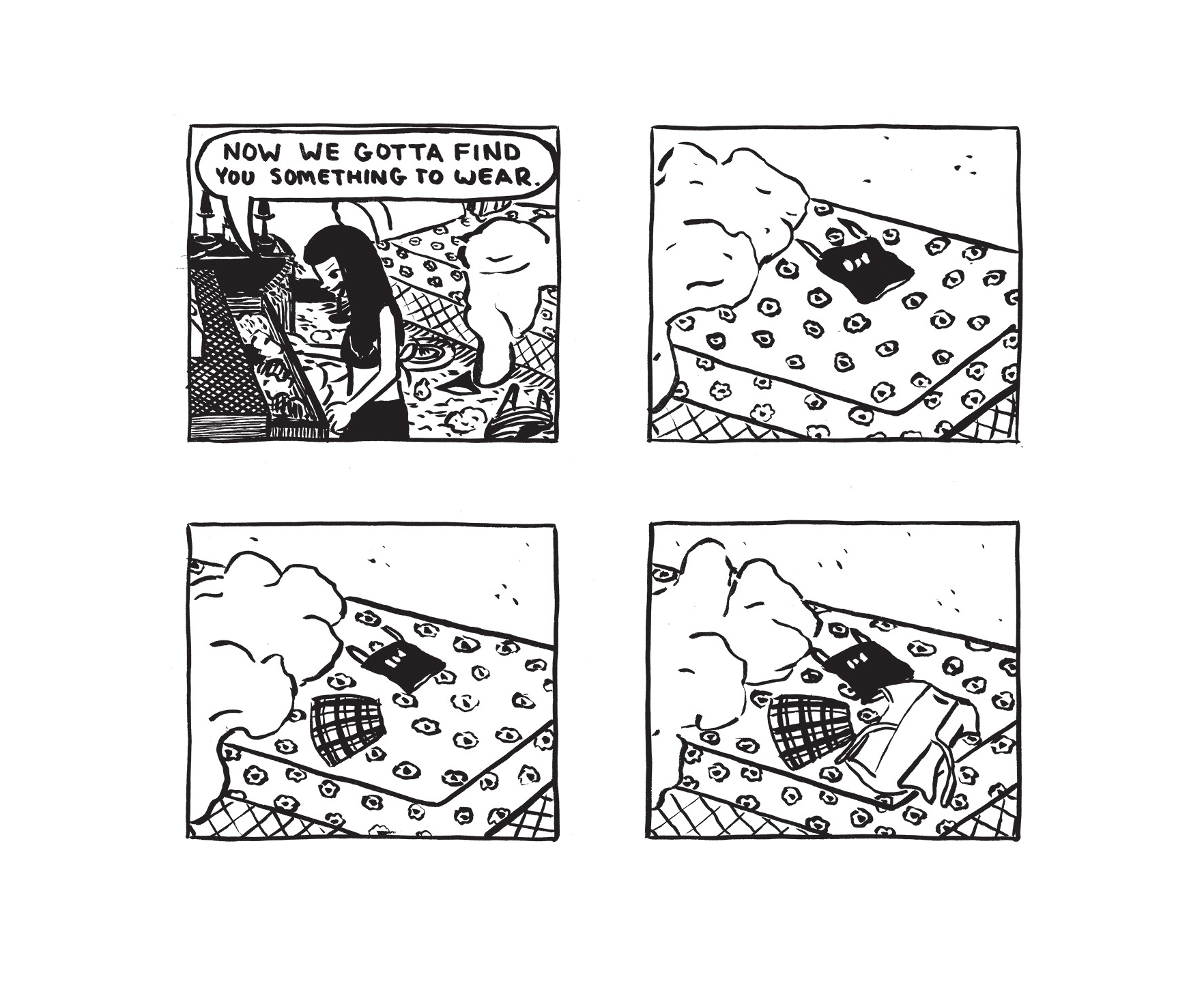
Jessica Campbell (
Rave) and Nicole Georges (
Fetch) spoke to one another as part of D+Q Live, a spring event series by the graphic novel publisher Drawn & Quarterly. The conversation centered around the release of
Rave—Campbell’s mordant and striking tale of a young woman coming of age within an evangelical, small-town community.
Both authors spoke about the risks of telling stories informed by truth, the grueling process of editing comics, and their respective relationships with their tumultuous religious backgrounds.
*
Nicole Georges: Did Lauren, the main character, come to you or did the events come to you first?
Jessica Campbell: The events came to me. I knew I wanted a protagonist that’s not exactly me, but I picture her as this passive person to whom events are taking place and she’s responding to them based on these voices that she hears through her friends or through church or whatever. So it was really the events that came to me first, but I knew I wanted that kind of character at the center of it.
NG: I was going to ask you where you end and she begins? What parts of your story do you see in her, or the people around her?
JC: Well, I think there’s much of this that’s coming from my own biography or my own upbringing in the church, my friends and situations that happened over the years. One of the dominant feelings that comes to mind when I think about my own adolescence is this feeling of immense insecurity and an immense lack of confidence, and feeling like I wasn’t even entitled to my own opinions.
That, to me, is central to this character, to the transformation that she goes through over the course of the book.
NG: I want to talk a little bit about the research that you did for this book, and what it was like to be around you during the three years that you were creating this book. I know you had to go to some dark YouTube places to write the dialogue as spot on as you did.
JC: A lot of the book is sermons or people—the youth minister, the pastor, or another kind of guest pastor—speaking. There’s such a particular cadence to it, at least in the States, and there’s something very powerful about that. It’s very evocative, and hearing someone speak that way makes me feel kind of queasy, but I wanted to be able to capture it as accurately as possible.
However, it’s been a long time since I’ve attended church regularly, so I went to YouTube and did some deep dives. I was specifically looking at sermons about women and girls and sex and things like that. I was triggering myself listening to them, but it was helpful. I realized one guy just kept repeating himself over and over again. Like, “You feel me? You feel me?” There’s this trance-like facet to it.
NG: I want to geek out for one second on your process. I just feel so strongly about editing in comics. And I know that you have so much experience as a reader, as somebody who worked at D&Q, as a writer, and a professor. I want to know what your editing process was like, and how important editing was to you on this project?
JC: Editing in comics seems extremely difficult to me. Especially if you’re writing a longer form book, you can’t just go back and put another panel in page ten, you have to put in multiple pages to edit anything. Previously, I just worked directly from thumbnails. Or an outline, then thumbnails, and then the final book. But I wanted the dialogue to feel real. I wanted the pacing to be a little bit slower than in some of my previous work.
So, I had conversations with a couple of cartoonists—Nick Drnaso, who did
Sabrina, and Anya Davidson, talking specifically about her book
Lovers in the Garden. Both of them, for those books, wrote prose scripts, and then thumbnails, and then moved into a final stage. I’d just been hesitant to work that way, because I know Lynda Barry just puts pen to paper, and then it’s like magic. Or Chris Ware, similarly, doesn’t outline anything. And they’re two of the greatest living cartoonists.
For me, having this extra layer of editing started with point form notes, and then prose expanded from there, before moving on to a script. It made the book a lot stronger than I’d been able to do previously.
Read the rest of the interview on
LitHub!