As of
July 2, 2021, only 14 out of the 240 registered Korean survivors of Japan's military sexual slavery are still alive. This number diminishes even further when compared to the
estimated 100,000—200,000 Korean girls and women kidnapped to serve as comfort women.
To start, the term comfort women is a misnomer.
And that is how the biographical graphic novel
Grass by Keum Suk Gendry-Kim opens.
On the very first page, nestled right above a flowering tree, she writes:
The term 'comfort women' is widely used to refer to the victims of Japanese military sexual slavery. A direct translation of the Japanese euphemism for 'prostitute,' ianfu, the term continues to be controversial...since it reflects only the perspective of the Japanese military and distorts the victim's experiences.
Despite the failings of the term, this is the most common phrasing used to refer to this specific form of sexual slavery and the word that Gendry-Kim uses in
Grass.
Grass details the journey of survivor Lee Ok-Sun (referred to as Granny Lee Ok-Sun in the novel), a Korean woman in her 90s who was sold off as a laborer at 14 years old and kidnapped to be a comfort woman just a year later. She now lives at the
House of Sharing in Seoul, South Korea where author Gendry-Kim met and interviewed her.
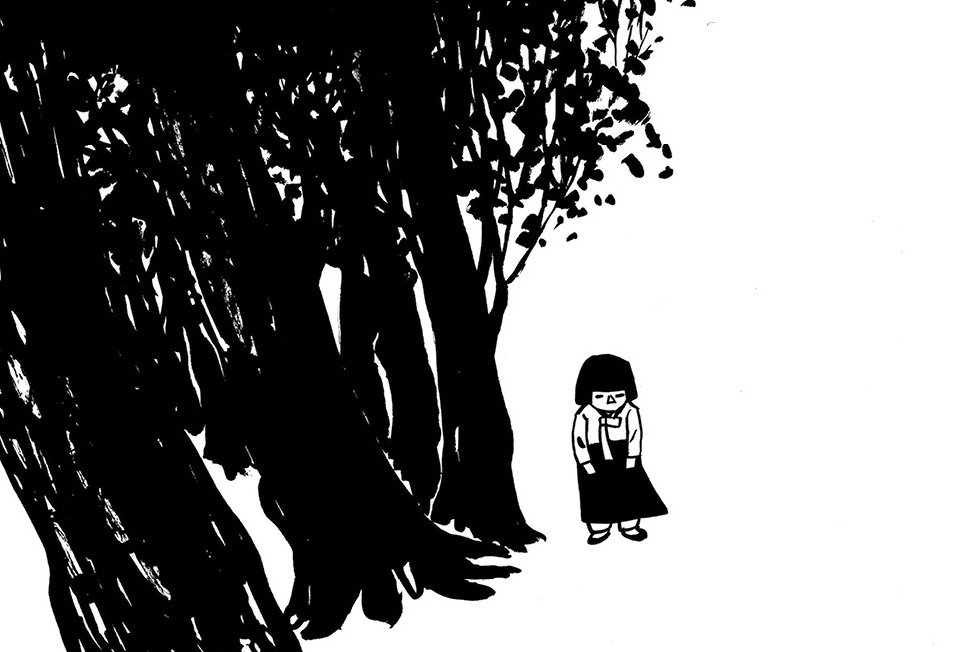
This graphic novel is told in black inky paintings with black and white panels. A visual novel may seem like an odd choice to tell such a dark story. Yet, this form amplifies the impact of the story and offers the reader a respite as well.
Instead of just reading the last conversation between Granny Lee Ok-Sun and her father, the reader sees her young face light up with hope and excitement when her father tells her she will work at an udon shop and go to school.
Food was scarce during the Japanese occupation, and only boys were allowed to go to school. Although Granny Lee Ok-Sun would be separated from her family, the udon shop would fulfill her basic needs and dream of getting an education.
On her last night with her family, her father combs her hair and gives her life advice against the setting of a white backdrop. Each panel is all white up until the very last one when the conversation reaches its climax.
The completely black final panel contrasts sharply from the rest. Her father, etched in white, has his back to her as a young Granny Lee Ok-Sun sits on the floor—grinning wide—promising her father, "I'll make lots of money, so the little ones won't go hungry."
This visual illustration deepens the betrayal of her parents and loss of innocence as every promise made to Granny Lee Ok-Sun is broken. She would never get the education she was promised, and she would never see her parents again.
The udon shop owners sell her off to a tavern after months of miserable working conditions and begging to return home. While working at this tavern, Granny Lee Ok-Sun is kidnapped by two Korean men. They hand her over to Japanese soldiers who traffic her to work in a comfort station in a different county.
Read the rest of the review
here!