

Art Spiegelman talks Maus, his long career in ‘comix’
Metro News | Mike Donachie | December 18, 2014
Metro News | Mike Donachie | December 18, 2014
Art Spiegelman likes telling long stories.
He’s the creator of Maus, the only graphic novel ever to win a Pulitzer Prize. It is, by design, a long story.
Ask him about it, as Metro did during one of his rare visits to Canada, and it leads to a lengthy conversation about art, tragedy, and, inevitably, the Holocaust.
Spiegelman is a chatty man, which might come as a surprise to anyone who’s read his intensely personal, dark works.
As he talks privately in a side room at the Art Gallery of Ontario in Toronto, which is showing a retrospective of more than 300 pieces of his work, the former chain smoker puffs on an e-cigarette, looking distinguished with his waistcoat and grey goatee.
Earlier, in an interview with more members of the media, he chuckled when he talked about being “trapped” by Maus, the thing he made.
But it established him as one of the most important figures in his medium, gaining him a special Pulitzer in 1992.
The personal nature of Spiegelman’s work is a vital part of it, he later says.
It draws on his background as a seminal figure in North American underground comix, as he prefers to spell them.
“To be able to do comix that were personal seemed to invite and build a different kind of storytelling,” he explains.
Maus is the story of his parents’ experiences during the Holocaust, including their time at Auschwitz, and how Spiegelman interviewed his father about that time.
It came from an ambition to create “a very long comic book that needed a bookmark and could be reread.”
Its creation is, in itself, a long story, starting in 1972 with Funny Animals, an underground comic that featured anthropomorphic creatures.
Invited to submit a story, Spiegelman chose a bedtime tale of Jewish life under Nazi Germany, entitling it Maus. It depicts Jews as mice and Nazis as cats.
Soon afterward, he wrote and drew Prisoner On The Hell Planet, as a way of recovering suppressed memories of his mother’s suicide.
“I just grabbed paper and started getting it down as it came to me,” Spiegelman says. “I had to do it.”
By the end of the decade, the two works had come together in the longer-form Maus.
Interestingly, Spiegelman says he’s “not that competent” as an illustrator.
He’s happy to call himself a “cartoonist” or “comics artist” but he’s more of an all-round storyteller, changing his style each time he tackles a new subject. He calls it a “process of reinventing the wheel.
“Everything I do leaves me collapsing at the end and having to reinvent myself,” he says.
“It’s difficult to keep doing that as we move on in the world and your bones get weary.”
Long career
The work of Art Spiegelman isn’t limited to Maus, but he’s no stranger to tough subjects.
About the show:
Pages from Maus form the centrepiece of the Spiegelman retrospective at the Art Gallery of Ontario. CO-MIX: A Retrospective provides insight into how they were made, with early treatments and sketches presented next to many of the dozens of pages.
In another display case are personal items like family photos and a copy of the arrest order that sent his parents to Auschwitz.
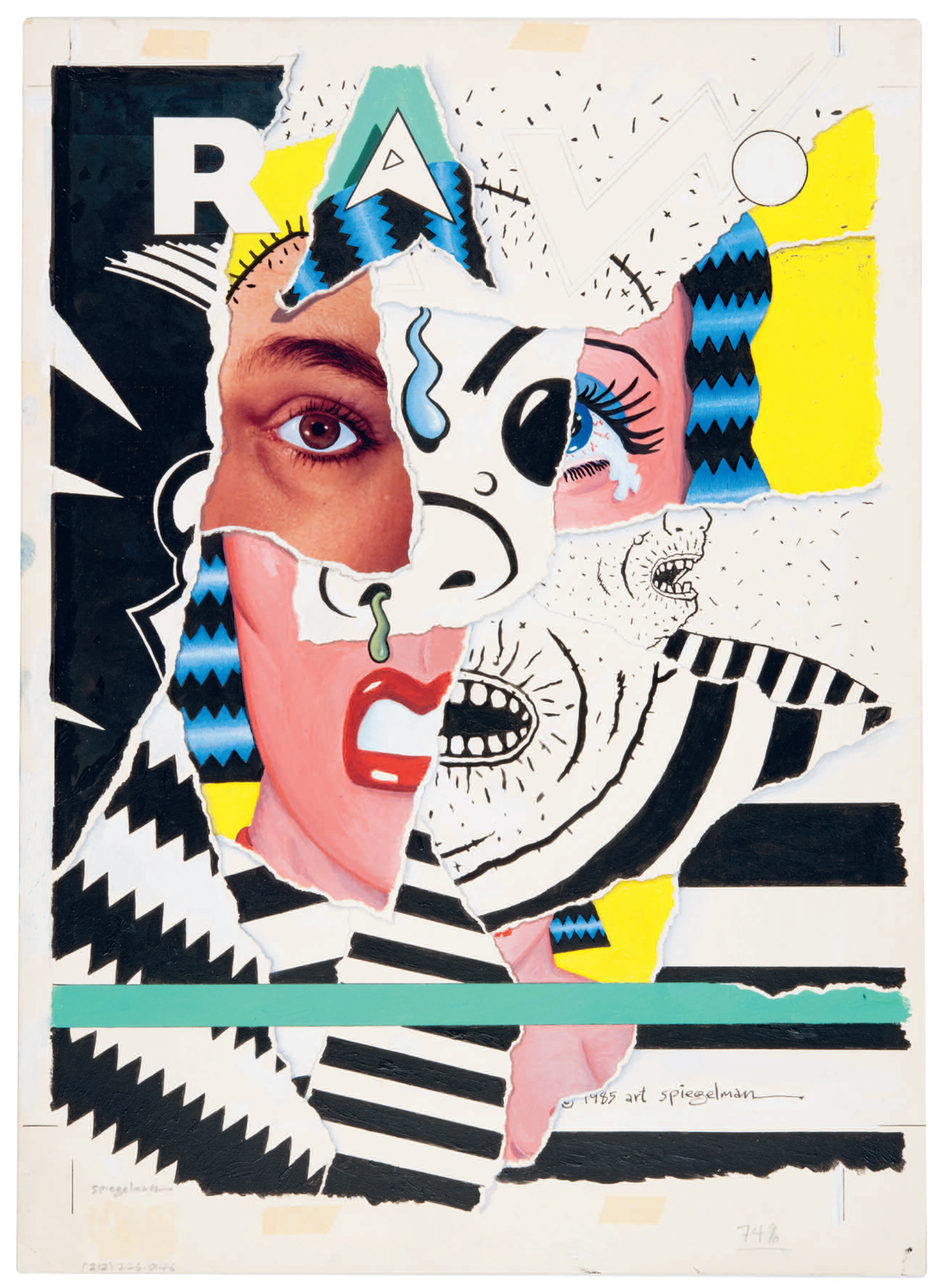
Also, there’s his early work in underground comix, and his commercial wok for Topps Bubblegum cards, which included the creation of the Garbage Pail Kids.
There are also his covers for the New Yorker, including the iconic 9/11 cover showing the black Twin Towers against a black sky, and an image of a Hassidic Jew kissing an African-American woman, published during a time of racial tension.
The exhibition is open from Dec. 20 to March 15.