

Comics That Stare Into the Face of Terror and Loneliness
New York Times | Hillary Chute | April 17, 2020
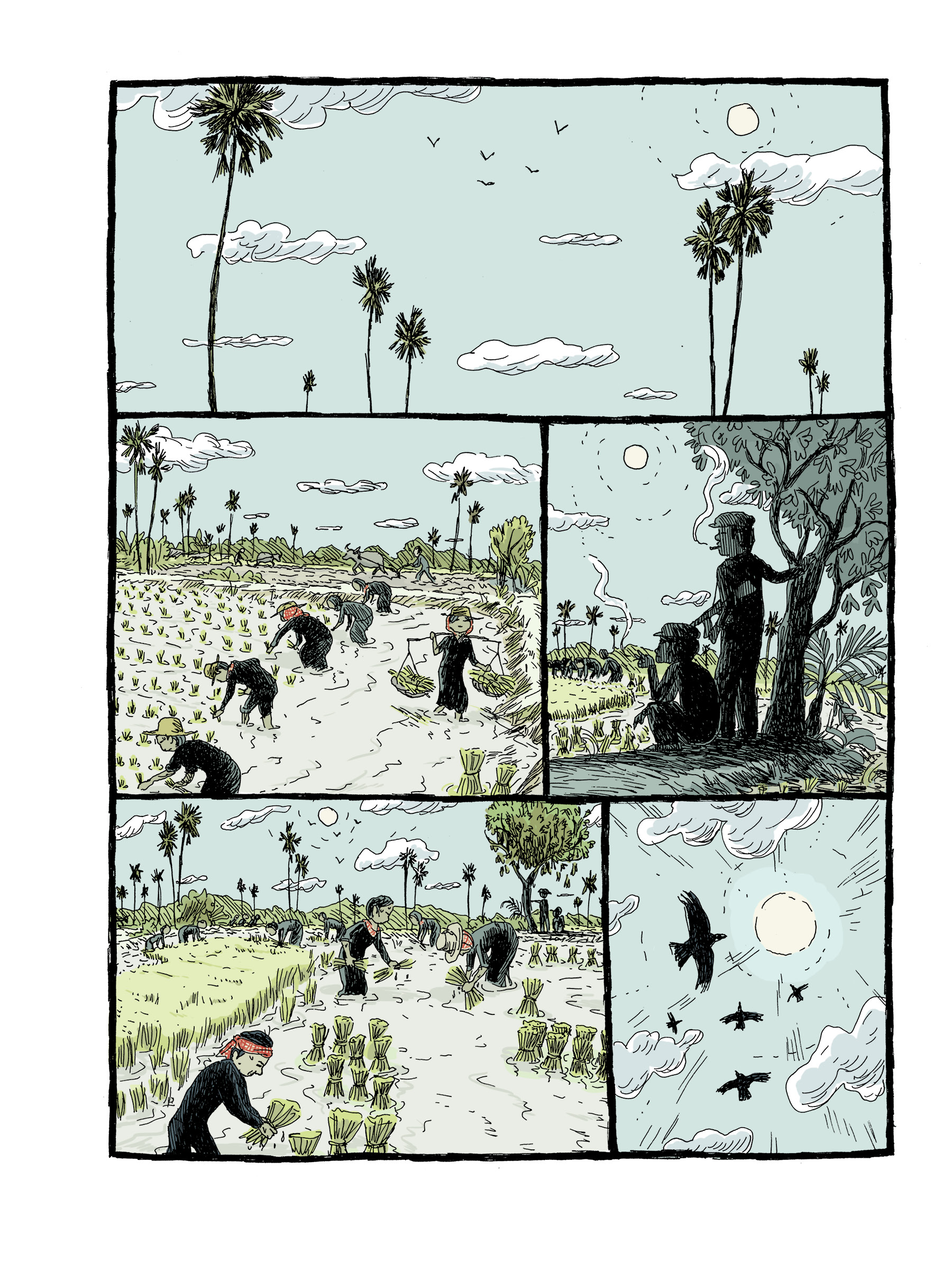
New York Times | Hillary Chute | April 17, 2020
In 2013, the director and writer Rithy Panh released “The Missing Picture,” a documentary that covers the Khmer Rouge’s takeover of Cambodia and the atrocities perpetrated by that regime (formally known as the Communist Party of Kampuchea), which massacred nearly two million citizens during its almost four-year reign. Panh was 11 when his family was expelled from Phnom Penh, and he witnessed the death of his parents. “The Missing Picture” deploys animated clay figurines for its narrative, forcing viewers to confront how they see and imagine violence. Panh writes the preface to Tian Veasna’s comics volume YEAR OF THE RABBIT (Drawn and Quarterly, $29.95), another important attempt to visualize from the inside what the experience of constant fear, cruelty and starvation was like for the millions of Cambodians imprisoned in brutal work camps, and murdered by the Khmer Rouge. Veasna, remarkably, was born just three days after the April 17, 1975, takeover, while his parents were on the run.
Translated from the French by Helge Dascher, “Year of the Rabbit” chronicles the struggles of Veasna’s extended family, based on his interviews with surviving relatives. Veasna eventually immigrated to France as a political refugee. This page-turner plunges us from the start into the chaos without the mooring — and the editorializing — of an overarching narrator (Veasna forgoes the first person entirely). It focuses tightly on the journey of one intergenerational family group (the family tree at the outset is helpful), who had been affluent and is therefore deeply suspect in the new regime. Veasna’s father, Khim, is a doctor who must pretend to have been a vendor, but whose medical skills and previous care of patients win him some favors at key moments in their story. The comics form allows the book to balance two significant angles that are held in tension: It sticks closely with one family, helping readers understand through chronological progression and a close view how horror can become the stuff of the everyday. And each of its 21 chapters opens with what feels like its own prologue, a page or two that pulls back from the immediate story to offer information on a different scale and plane: maps, diagrams, organizational charts and embedded comics within the comic that reveal how the Khmer Rouge worked. Further, “Year of the Rabbit” uses the hybridity of word and image to dramatic and ironic effect, frequently allowing the propaganda blaring from speakers to be contradicted by the drawings that unfurl on the page. Veasna’s line is loose and modest, particularly in his stripped-down rendering of faces.
While printed on a white page, his panels are bordered in black and separated by black gutters, a technique that lends the book a dark tone and suggests the suffocating omnipresence of the Khmer Rouge. The book offers an eerie, muted palette of mostly secondary colors. Pages can feel waterlogged, drained of vibrancy; a queasy light green is a frequent backdrop. “Year of the Rabbit” evokes, even if it can’t replicate, a taste of the relentlessness its central players and millions like them endured. When Veasna’s mother declares, “I’ve dreamed of this for so long — living without the constant fear of death,” it is striking, and moving. Veasna does not turn away from the brutality; I paused and read and reread a page in which children are killed during the elliptical moments comics are known for, in which the circumstances are clear (pickax, ditch) but readers themselves are put in the position of imagining the precise action outside the frame. But there are moments of beauty as well, as in a lovely silent panel of 4-year-old Veasna, eyes closed, draped on his father’s back as the two flee in the dead of night toward a refugee camp across the Thai border, the child surprisingly serene in the face of risk he cannot comprehend.