

Review
The Vassar Review | Jeff Alford | June 28, 2021
The Vassar Review | Jeff Alford | June 28, 2021
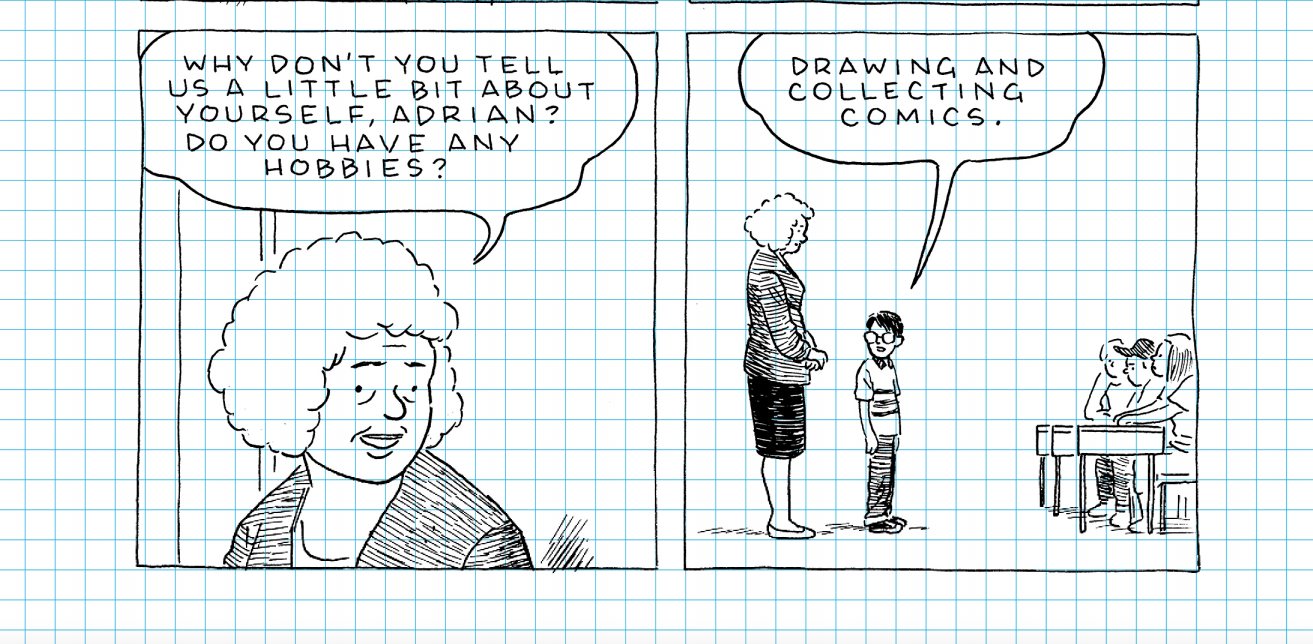
It's not a corning-of-age story in the traditional sense, but one of corning to a particular age. In a series of anecdotes spanning the past forty years of the author's life, The Loneliness of the Long-Distance Cartoonist traces how a Spiderrnan-loving dweeb grew into the "boy wonder of mini-comics," and later into an over-thinking worrywort of an adult, quietly searching for affirmation that the path he chose was the right one.
At once an immaculately-drawn industry memoir and a self-effacing existential crisis, Tomine's crafted a gorgeous and relatable diary that will wow readers smitten with his literary bravado and effortless penwork, all while delighting those looking for an insider's perspective. Although the majority of Tomine's stories lean heavily on embarrassing memories, many bits will thrill fans of his circle: it's fun to see Daniel Clowes's old apartment in 1996, and to sit through a terrible book signing with Seth a year later.
But most stories transcend their behind-the-scenes charm and demand a more substantive appreciation. Beautifully drawn and expertly plotted, Tomine's stories invite readers to explore themes of memory, identity, and the curious ways the two interact. These vignettes recount moments from the author'slife that have clearly haunted him, but readers are left to savor not the shame of the incident but the meticulousness of the artistry used to illustrate each social trauma. In one scene, Frank Miller makes a joke about Tomine's name while presenting him among a list of Eisner nominees ('Tm not even gonna try to pronounce that one!"): instead of awkwardness, readers will marvel at the captivating visual contrast between Miller at the podium, snarling from the corner of an otherwise bare frame, and Tomine, wearing a too-long tie, slumping in his seat in the audience.
Above Tomine floats the black void of the low-lit auditorium as sweat droplets, clapping sounds, and the laughter of strangers cut through in negative whiteness. In another story, set a decade later, Tomine's being interviewed on NPR's "Fresh Air:' It's a disaster. He's nervous and jittery, as if his brain decided ahead of time to sabotage the whole thing. He falters and giggles throughout his conversation with Terry Gross, but these humiliating gaffes are beside the point: what lingers for readers is Tomine's exceptional pacing in recounting the incident, his conniving inner monologue (rendered here as a hyper-critical phantom twin). and his restrained use of color. Like all the stories in the memoir, this episode is lessabout embarrassment and more about how moments can be reframed and refined, polished and laughed at until they become something different.
Throughout the memoir, Tomine transmutes weighty flubs into cartoon gold. It's alchemy at work. Another remarkable transformation takes place in Long-Distance Cartoonist. So much of the memoir is concerned with the author searching for his identity and sizing up where he belongs in the pantheon of literary cartoonists. Throughout the book, we see Tomine as Clowes's houseguest and as Seth's co-headliner on a book tour, and in one story, Neil Gaiman's signing line fills the background of a series of frames. In each of these memories, Tomine ponders his own success and where that might place him in relation to his peers. But over the years (and into his own adulthood and parenthood), it seems he's quietly drifted towards the spirit of another cartoonist. Halfway through the book, we see Tomine in 2011. He's married, pushing a stroller, his baby finally asleep after a hilarious public meltdown. Shooting up from the stroller is a single "Z" that all comics fans should recognize: the thick lines and hooky serifs of a deep Schulz snooze, frequently seen over Snoopy atop his doghouse. And with that "Z", a few curtains in Long-Distance Cartoonist slowly drop.
After all that soul-searching, could Tomine, now a father, have landed in a place more Peanuts than Eightball? "Hortisculpture" from 2015's Killing and Dying comes to mind, as does 2011's Scenes from an Impending Marriage. And here, what about the endless inner monologuing, the incessant fountain of sweaty droplets? Tomine's jokes often land like a Peanuts strip, zinging the story's last frame with loveable, low-key defeat. In some scenes, his daughters even wail from kidney-shaped voids, clearly invoking a Charlie Brown "Aaugh!" There's a maturity to taking inventory of one's own follies through this Schulzian lens, finding opportunities for growth in every yoinked football. "My clearest memories related to comics," Tomine explains at the end of the memoir, "about being a cartoonist -- are the embarrassing gaffes, the small humiliations, the perceived insults ... "
This may sound depressing, but it's also weirdly life-affirming, proof of persistence and heartfulness. To borrow another bit from the Peanuts gang, Tomine's stories are the good kind of grief, as so much of growing up is