

After a Climate Catastrophe, These Birds Flocked to the Moon
New York Times | Etelka Lehoczky | September 2, 2022
New York Times | Etelka Lehoczky | September 2, 2022
A new release from Michael DeForge should be met with trumpet blasts across the length and breadth of the book world. With his artistry, intellect and wit, it’s a mystery why he hasn’t been dubbed the next Dan Clowes or Chris Ware by now. Not that DeForge’s style bears any resemblance to those two standard-bearers of ’90s comics — or that he hasn’t collected his share of praise (plus a smattering of awards) since he began publishing in the late 2000s. But he deserves to be known even by those who don’t necessarily follow comics.
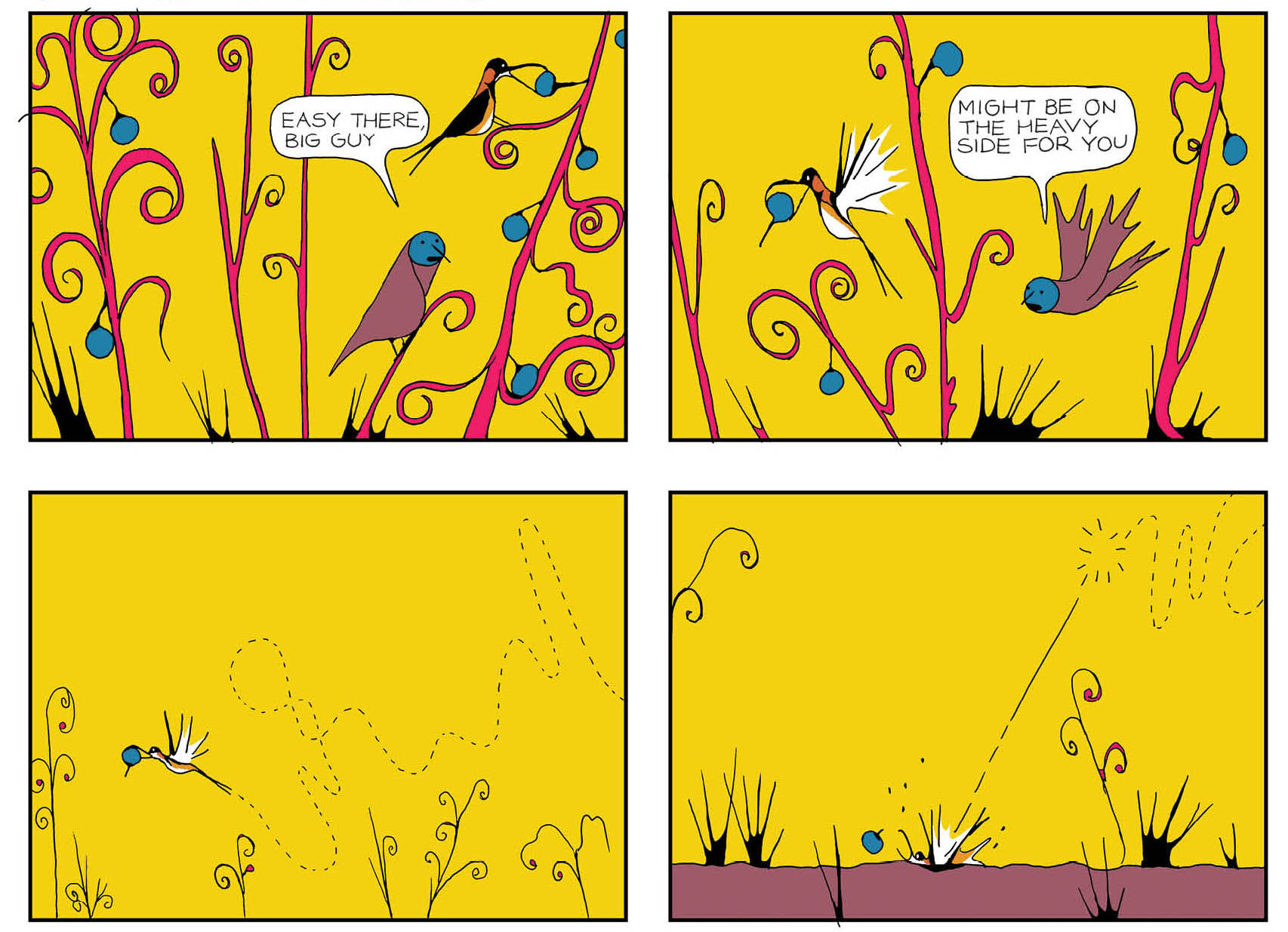
Like two of its predecessors, “Sticks Angelica, Folk Hero” and “Leaving Richard’s Valley,” “Birds of Maine” began as a webcomic. Its subject is absurd: an imaginary society of birds living on the moon. They may have left their home planet behind, but these are Earth birds with Earth concerns. They’re alternately jealous of and attracted to one another’s plumage and wingspans. They’ve created an internet out of terraformed fungus, which they use to communicate and record their history. Three adolescents are at the center of many of the book’s strips, and they act like teenagers everywhere. They form a band, but worry that their songs are monotonous: “They can’t all be about alerting other birds to nearby food sources.”
The first striking thing about “Birds of Maine” is DeForge’s trademark abstraction. It’s difficult to tell what any of his drawings represent without some squinting, at least until you get used to his unique style. Though his compositions nod to the work of great artists, it’s his sly, accessible sense of humor that paradoxically gives “Birds of Maine” its intellectual payload. Most episodes have the same rhythm as the Sunday funnies, with similarly corny punch lines. This doesn’t only prevent the reader from equating abstraction with the highbrow. It quietly compels her to ask what does, and doesn’t, count as “serious” art.