

New York Times Reviews Mary Wept Over the Feet of Jesus
New York Times | Douglas Wolk | June 1, 2016
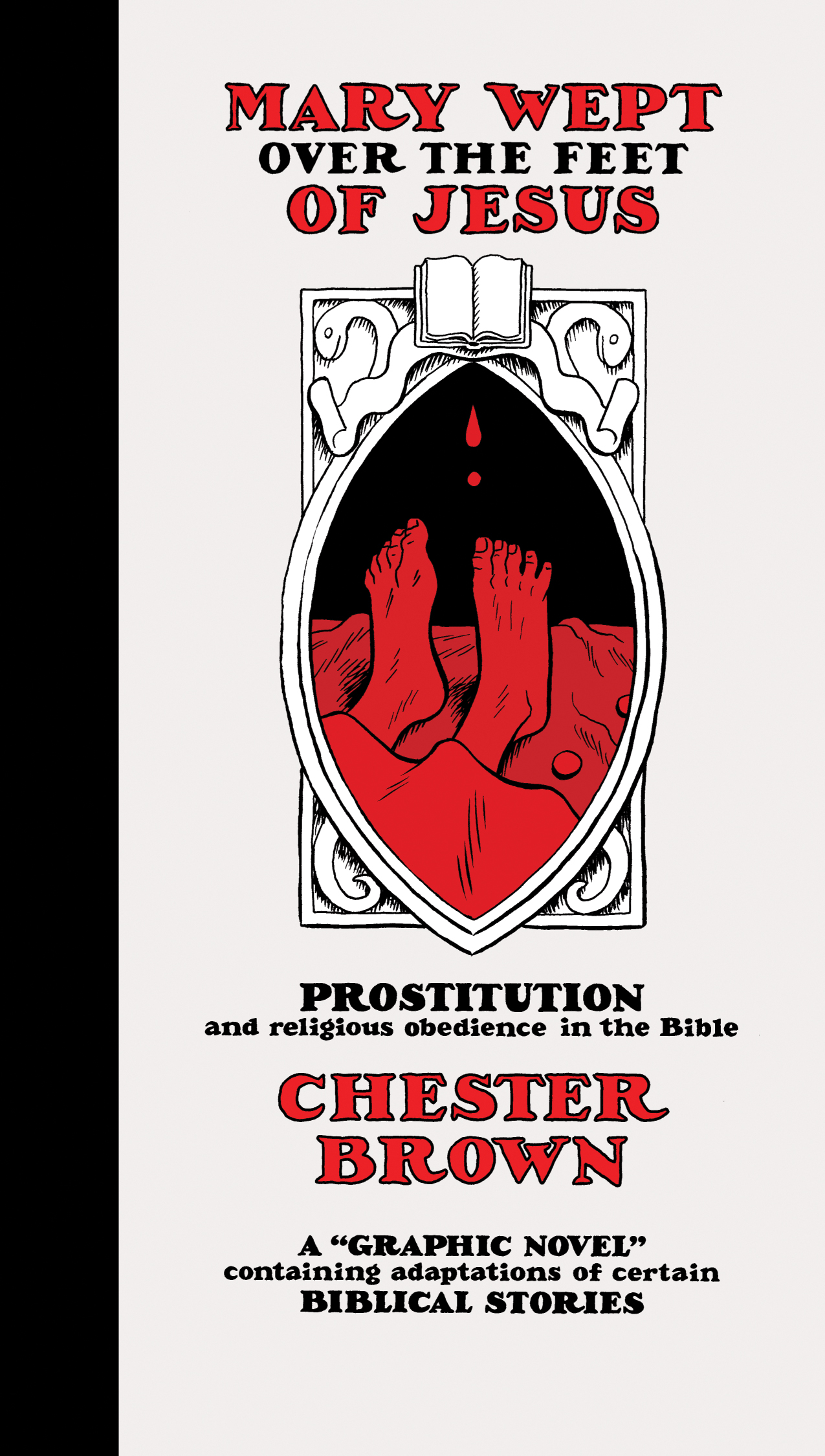
New York Times | Douglas Wolk | June 1, 2016
With a bit of effort, it’s possible to make Scripture imply almost anything you want it to, and the gifted, intensely odd Canadian cartoonist Chester Brown has performed an impressive feat of creative reinterpretation with Mary Wept Over the Feet of Jesus: Prostitution and Religious Obedience in the Bible. Brown has been fascinated with both elements of his subject for a long time: Prostitution was the subject of his 2011 memoir, “Paying for It,” and his early comics included remarkable adaptations of the Gospels of Mark and Matthew. His argument here is essentially that both Jesus’ mother, Mary, and Mary of Bethany were prostitutes, that God favors those who disobey Him in the interest of a loving life and that the Bible has been redacted to obscure both assertions.
As biblical scholarship goes, this seems fairly iffy. (Brown chides other scholars for recounting stories with “fanciful elements seemingly of their own invention,” even as he notes that he changed details in the parable of the prodigal son “to reflect how I think Jesus told it.”) As art, on the other hand, it’s pretty wonderful. As Brown’s extensive (hand-lettered) endnotes explain, the book grew out of what was initially intended to be a self-published minicomic based on a lost variation on Jesus’ parable of the talents, cited by the fourth-century historian Eusebius. (Brown’s take on that parable — that the “good and faithful servant” was one who spent all of his master’s money on prostitutes and flute players — does indeed make for a more dramatically satisfying story than the familiar version.)
The bulk of the book is Brown’s adaptations of Bible stories, some very familiar and others less so, all given some degree of explicitly interpretive spin. His evenhanded pace of four small panels on each page keeps the tone understated, and he gets a lot of comedic mileage out of rendering biblical dialogue into modern vernacular. (Jesus, on being told that he should be anointed, replies, “I don’t know — I’m not into ceremonies.”) But Brown zeros in on the human drama in each story — his images of David silently regarding Bathsheba make very clear the way power flows between them — and his visual craftsmanship is as sharp as it’s ever been. Brown’s drawing on the book’s front cover alludes to the historiated initials of illuminated manuscripts, even as it presents the Bible as a clitoris.
The only section of “Mary Wept” that’s entirely speculation on Brown’s part concerns Matthew working on his Gospel, wondering how to hint that Mary had been a prostitute without having that revelation censored by scribes, and deciding to invent a genealogy for Jesus that included several women who “took the sexual initiative for social advantage . . . I hope that, eventually, readers with eyes to see will understand.” He hid his meaning well if it took close to 2,000 years for a curious artist to catch on.