

Full cycle — New graphic biography helps make Major Taylor accessible
Worcester Magazine | Richard Duckett | August 26, 2026
Worcester Magazine | Richard Duckett | August 26, 2026
For people living in Worcester, the dramatic and inspiring story of 1899 World Bicycle Champion Marshall W. "Major" Taylor has become literally part of the local landscape in recent years.
There has been the naming of Major Taylor Boulevard, the unveiling of a statue at the Worcester Public Library and the opening in 2021 of the Major Taylor Museum.
But despite the revived recognition here following years of obscurity, outside of Worcester the story of Taylor still needs some telling for his legacy to get its full due, said Oakland, California, artist Frederick Noland. "More and more people are hearing about him, but just not enough," he said.
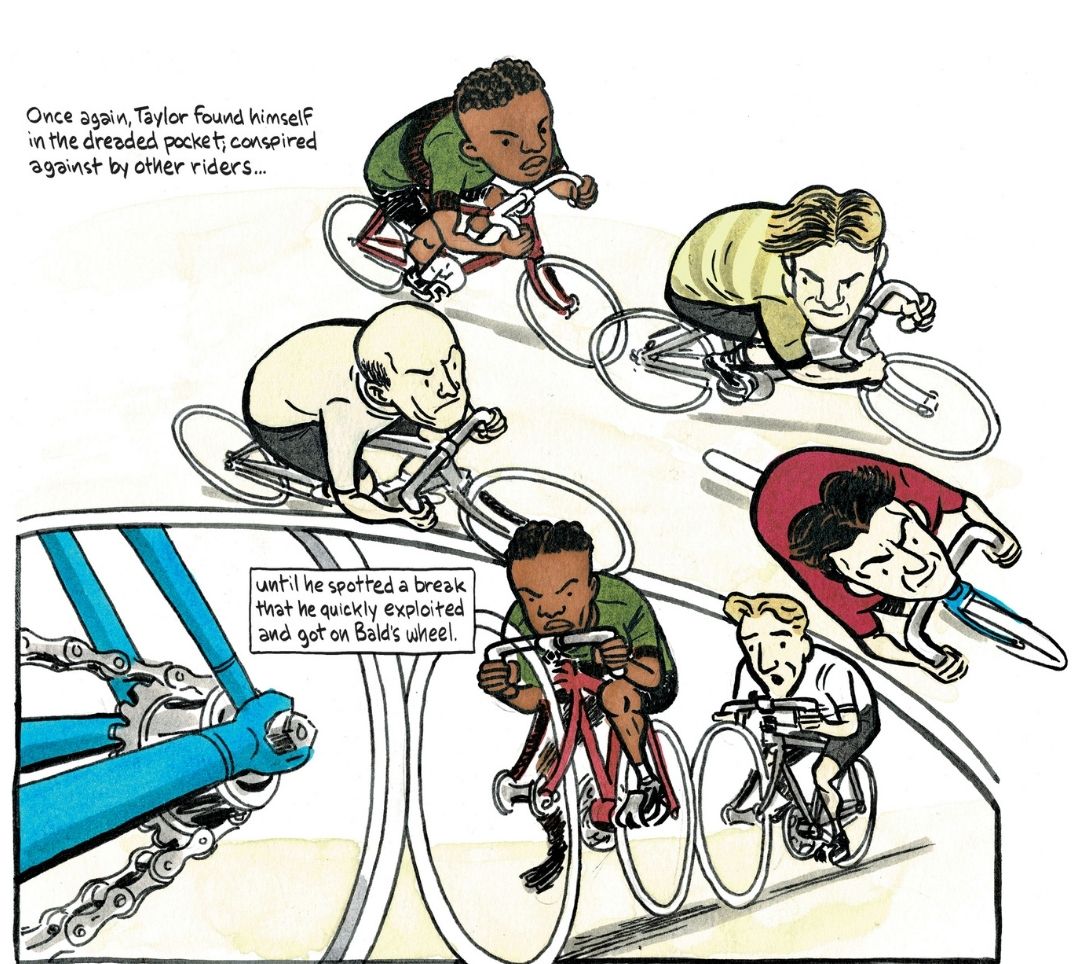
Noland, who has a passion for unearthing the untold stories of Black American heroes as well as cycling, hopes to make the wheels of Taylor's legacy turn faster for more people with his epic, 400-page graphic biography "Major Taylor: The World's Fastest Man," to be officially published by Drawn & Quarterly on Sept. 8.
Noland, the author and illustrator, will be at the Major Taylor Museum, 2 Main St., Worcester, on Sept. 9 to discuss his book in conversation with Lynne Tolman, president of the Major Taylor Association. Admission is free. TidePool BookShop of Worcester will handle book sales.
'You're in the crucible," Noland said about Worcester and Taylor when talking on the phone recently. However, as Noland was doing his research for the Taylor book he said it was "amazing how many people were, 'Who is this guy?'"
'The Worcester Whirlwind'
Taylor (1878-1932) was born in Indianapolis but lived much of his adult life near Columbus Park in Worcester. Here he was known as "The Worcester Whirlwind" for his phenomenal athleticism and cycling prowess. Contemporary reporters worldwide called him "the fastest man in the world."
"He's someone who should be spoken about with the same reverence as Jesse Owens," Noland said of the Black American track and field athlete whose triumphs infuriated Adolf Hitler at the 1936 Berlin Olympics.
Taylor also won races while facing racism. He came to Worcester from Indianapolis in 1895 when bicycle manufacturer and racer Louis "Birdie" Munger, who mentored Taylor as his racing protégé, moved his operations from Indianapolis to Worcester. Munger was trying to take advantage of the biking boom and find a more tolerant racial atmosphere.
Taylor raced on the East Coast Circuit and then abroad in Canada, Europe and Australia. At one point he set seven world records in a year. He drew crowds in the tens of thousands. The first Tour de France was funded through Taylor's sold-out European races.
But in the United States particularly pernicious racism continued to rear its ugly head. When Taylor won races in the U.S., at the subsequent award ceremonies, rather than play "The Star-Spangled Banner" bands would perform "Dixie" instead. Although Taylor accumulated wealth as a cycling professional, at the end of his life he had moved to Chicago and died impoverished.
For a long time Taylor seemed to be have been forgotten both locally and nationally. Then, bit by bit, interest in him renewed.
'A machine of freedom'
Noland, who describes himself as "an avid but unremarkable cyclist," said he first became aware of Taylor while doing laps and getting drafted by some other cyclists using his slipstream. Normally, "you say hi and they go on with their day. [But] they just passed me and didn't say a word."
While Noland thought that this was a bit rude, he noticed their T-shirts said "Major Motion" and wondered what that stood for. "I looked it up, and I've been obsessed with it ever sense." Major Motion was a cycling club named after Major Taylor.
"Major Taylor: The World's Fastest Man" begins with a history of the bicycle and how it became "a machine of freedom."
From the draisine of the 1860s, where people scooted along, to the "great leap forward" of pedals in the French velocipede, Noland shows how bicycles offered an alternative to the horse for everyday transportation beyond walking. At first they were for the rich, but then working people could afford them and it transformed society. There were risks on the bumpy trails. Norland quotes Mark Twain's observation, "Learn to ride. You will not regret it. If you live."
Soon, cycling became a sport, "a blood sport" as Noland describes it, with "broken bones, lost teeth and sometimes lost lives." It was also an incredibly popular sport.
The black-and-white illustrations turn to color when Noland introduces young Marshall Taylor in Indiana. Taylor is denied admission to the Indianapolis YMCA because of the color of his skin but wins his first race at 11. "I can do this. I'm every bit as good as these other wheelmen. And a better sport by far!" Taylor says in Noland's gripping depiction of the race. No one expected Taylor to last very long in the race, but then the crowd sees Taylor out in front heading to the finish line. "Goodness! It's that little boy!" a spectator exclaims.
"Major Taylor" is Noland's first full graphic biography, he said. His comics and illustrations have appeared in a number of publications, including The New Yorker and LA Weekly. He created a series of posters to commemorate Black History Month and to highlight several trailblazers who helped pave the way for change in San Francisco, including Maya Angelou, William Cobb, Sly and the Family Stone, Cecil F. Poole and Supervisor Doris Ward.
His research for "Major Taylor" took several years, and he came to Worcester in 2016 to meet Tolman, who showed him the Major Taylor statue.
Working on "Major Taylor" and "knowing Lynne is going to read this [I thought] I have to make sure this is really good," Noland said.
But Noland said he was hampered somewhat by a dearth of material. "I came across a few books. Fortunately a little more came out on him [recently]." There's been very little written about Taylor by Black Americans, he noted.
Taylor did write his own autobiography, but Noland said, "It's not very revealing. He's not a writer." Noland did come across postcards Taylor sent from his travels that have a more natural voice.
Depicting the racism "was really extremely difficult [to write]. I was furious," Noland said. "I find him immensely relatable. He had to learn how to navigate the white world."
Falling into obscurity
Taylor was a very moral person, including being a pacifist who did not drink alcohol, Noland said. "He traveled the world in the 1800s and most people didn't leave their neighborhoods back then. You can just sense his presence of mind and resolve."
But of his final years, Noland said "unfortunately, he didn't handle his money very well."
Noland also "did a lot of of work on the history of the bicycle itself and cycling in France ... He [Taylor] was very famous in France at the time. You have to some digging to get some real stuff — getting the look and feel of the turn of the century."
In other media, "there's not a lot" about Taylor, Noland said. "There's a terrible TV movie from 30 years ago."
A Hennessy Cognac VS ad from 2018 lauding Taylor was surprising given that Taylor did not drink. "Why would you put him in an ad for alcohol?" Noland asked. "I worry about his image and his story not being told right."
But the early word on Noland's "Major Taylor" is highly encouraging.
Kirkus in a review calls it "a rousing tribute to an athlete whose star has dimmed over the generations but deserves to shine again."
Writing for Library Journal, Thomas Batten said, "Noland’s clean, expressive illustration underscores Taylor’s dignity, faith and resilience in the face of adversity. Noland brings kinetic energy to Taylor’s record-breaking races, rendering the action with palpable urgency. Yet the book’s real strength lies in its unflinching depiction of the systemic racism Taylor endured, from violent sabotage by competitors to exclusionary policies that followed him across continents."
Noland said he does not have a message in the book, per se. "More, my mission is to take this figure and make him accessible for more people."
His Worcester visit is part of a tour to promote "Major Taylor" with appearances also including Oakland; Bethesda, Maryland; Chicago and Detroit. He's going to different places on the map to help put Taylor on the map.
"We're adding more," Noland said.