In her book
Comics and the Body: Drawing, Reading, and Vulnerability, Eszter Szép analyzes Joe Sacco’s
The Fixer: A Story from Sarajevo in terms of haptic vision. Drawing on the work of Laura U. Marks, Szép explains haptic vision as the visible made tactile, “a mode of visual perception that is synesthetic in nature: It connects tactile and kinesthetic sensibilities with vision without the actual act of touch” (120). She describes the thickly cross-hatched backgrounds of
The Fixer as “haptically charged” (121), causing the reader to pause and to experience Sacco’s own embodied presence even in a space of absence. “[I]t is these surfaces and textures that Sacco has created to arrest the narrative flow and invite the reader to dwell in the world of the characters and contemplate” (130).
Travis Dandro’s
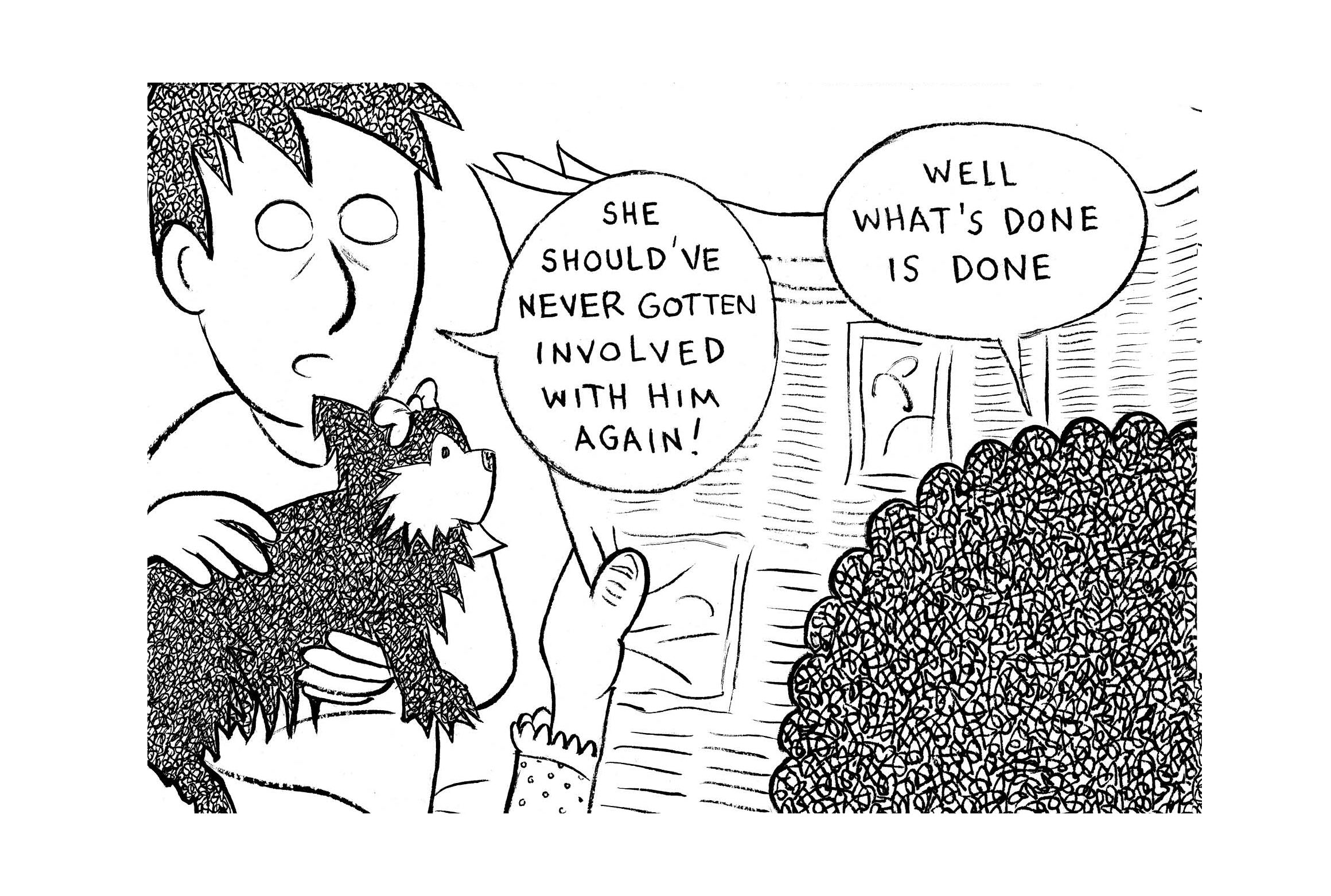
Hummingbird Heart, A Memoir is likewise haptically charged, with the many absences in young Travis’s life filling nearly as much space as the living. After an opening recto and verso title page filled top-to-bottom with scribbled tangles, these thatches recur throughout the story, spanning the night sky, blanketing the bedroom carpet, or filling the hair of Travis’s elderly grandmother Nana. To say that every instance of this idiosyncratic thatching (e.g., on a chalk board, as the dark of a room, in a cat’s fur) is symbolic would be overreaching. However, the way it nearly fills panels that are absent of characters – and marks Nana, who soon succumbs to her cancer – puts attention on them. Travis’s deadbeat father does not fill his life, his grandfather has passed on, and, after serving as one of her caretakers, Travis’s Nana will soon vacate this space, also. Readers are compelled to find something missing, even if Travis himself has difficulty facing it.
When not caring for his grandmother, Travis aims to be a carefree ‘90s kid, listening to grunge rock and getting into misadventures with his friends. His dreams of becoming a cartoonist are raised further when they take a day trip to the Museum of Cartoon Art in New York (now absorbed into the
Billy Ireland Cartoon Library & Museum). There, he imagines being amongst the famous strips, and the thatching returns to envelope the moon in Travis’s rendition of Little Nemo in Slumberland and the mountainside of Krazy Kat; the other comics homages (e.g, Peanuts, Calvin and Hobbes, Popeye) revert to traditional crosshatching, notably, suggesting perhaps greater kinship between Travis as the earlier cartoonists. When, later, he imagines himself as Robin Hood, the thick darkness is cut through by beams of heroic light, reinforcing their pernicious association.
After falling and breaking her hip, Nana and her family learn of the cancer diagnosis. A silence and silhouettes fill the next several panels and pages (akin to the “diagnosis deafness” theorized by A. David Lewis in his
Middle Spaces commentary). She refuses any chemotherapy treatment and begins refusing both food and water. The turmoil in Travis begins to crash through as he gets into fistfights with his friends, though they soon reconcile at Nana’s funeral. The art in
Hummingbird Heart turns darker and charcoal-smudged as Travis has an oneiric vision, a dream of being reunited with his grandfather and Nana as they drive to their cemetery for a final goodbye. The change of style signals to the reader that they are outside Travis’s everyday reality, perhaps even inside a manifestation of his own feelings and attempts at closure.
Nine months later, Travis leaves for art school, one result of which will be this very book. Though it meanders at time, the memoir does so thoughtfully and intentionally, compelling the reader to explore the space and feel an emptiness that needs filling. One hopes that, with
Hummingbird Heart, Dandro has found a way to give his autobiographical avatar of Travis that fulfillment.